
Introduction
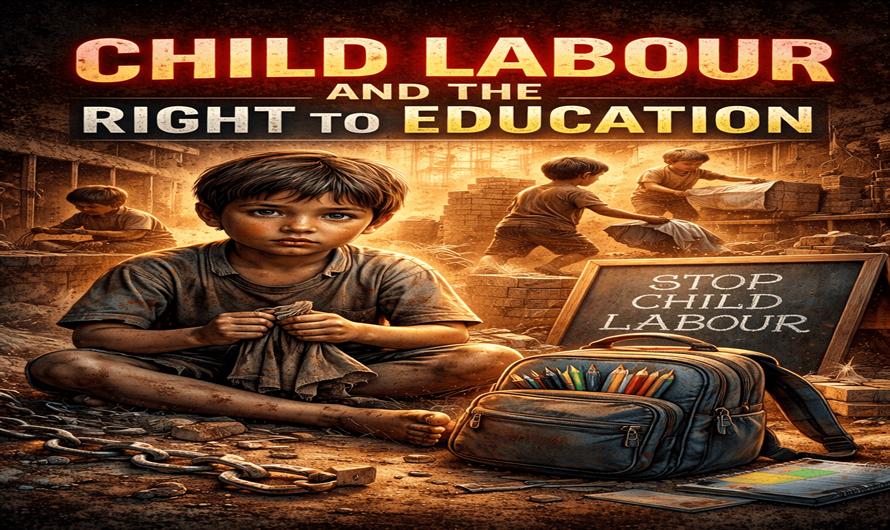
Children are one of the greatest gifts given to humanity. Childhood is very precious and it is an important stage for the development of children as they are the future of our society but they are constantly exploited worldwide in various ways and one of them is Child Labour. Child Labour means the use of children in jobs that are under the age of criteria of legal employment which deprive a child of his/her childhood which includes the basic need for a healthy environment, mental and physical development, and their right to go to school to acquire a better education.
The impact of Child Labour on the right to education of children is a very concerning problem that sustains the cycle of poverty, exploitation, illiteracy, and unemployment. Child Labour not only snatches the childhood of a child but also limits them from their future development and opportunities. Children have to work for hours and hours in harmful conditions which can have bad effects on their mental and physical wellbeing.
According to the United Nations International Children's Emergency Fund (UNICEF) – “Nearly 1 in 10 children are subjected to child labour worldwide, with some forced into hazardous work through trafficking.” Economic hardships lead various children into labour work which somehow snatches their right to education.
This blog gives a review of Child Labour and its Impact on the Right to Education of children in the global scenario. It talks about various International and Regional mechanisms that facilitate the eradication of Child Labour and help children get an education without their exploitation. This blog also delves into historical roots, challenges and solutions that will eventually protect the right to education of all children.
Historical Context
a) Pre-Industrial Era
Historically, Child Labour was a part of the pre-industrial economy. In those times the concept of childhood and education was very rare as compared to today’s time. Children used to participate in different activities such as hunting, babysitting and farming with their parents as soon as possible. In many societies and cultures children even under the age of 13 were expected to participate in work just in the same ways adults used to do.
In this era, Child Labour was very important because children had to work for themselves as well as their community for survival. The pre-industrial era consist of low productivity, short life expectancy and a non-literate society which prevents children from attending school and acquiring knowledge. Knowledge was passed down through direct training from competent adults.
b) Industrial Revolution
After the Industrial Revolution in Britain in the late 18th century there was a gradual increase in the exploitation of labourers which included Child Labour. Children as young as five or six started to work in production factories and mines as they could crawl through tunnels that were too narrow and low for adults. They also worked as errand boys, crossing sweepers, shoe blacks and sellers of cheap goods.
Child Labour played a significant role in the Industrial Revolution from its beginning, often as a result of economic hardship. Children of the poor were expected to contribute to their families for more income. Many children were also forced to become prostitutes in order to earn more and more money for their families.
Wages of children were 10% to 20% lower as compared to adult workers that’s why they were preferred. But in the second half of the 19th century, Child labour started to decline due to various regulations and economic factors.
c) Early 20th Century
In the early 20th century glass making industries, textile mills and cigarette factories gradually increased which eventually required more and more labour. As the cost of child labour was lower these factory and mill owners used to hire children mostly boys under the age of 16. When these children were at work they were exposed to intense heat and harmful substances leading to various complications like eye trouble, lung ailments, heat exhaustion, cuts and burns.
d) 21st century
Even in the 21st century Child labour is still common in many parts of the world and remains a significant global challenge that impacts millions of children around the globe and poses a threat to their fundamental rights, mostly the right to education.
In the 21st century education is very high which poses a significant barrier for the families facing poverty. In many cases, parents nowadays prioritize providing basic necessities like food and shelter over education due to financial inabilities.
In some cultures and communities work is prioritised over formal education leading children to go to work rather than schools, as their parents see education as less important. This is mostly seen in less developed parts of the countries where access to education is limited, eventually leading to the risk of Child Labour.
International Protection Mechanisms
1. United Nations Convention on Rights of the Child (UNCRC)
The United Nations Convention on the Rights of the Child is a legally binding agreement that sets out the civil, political, economic social and cultural rights of every child irrespective of their gender, religion, caste, colour etc.
The UNCRC was adopted by the United Nations in 1989 and consists of 54 articles and has been signed by 196 countries. These 54 articles consist rights of children and how governments should work together to implement and provide these rights to all children. Under this convention, the state must provide the basic needs to the children, help them to reach their potential and make them mentally and physically developed. It emphasizes that all children have fundamental rights.
These rights are:-
1. Non-discrimination (Article 2)
2. Best interest of the child (Article 3)
3. Right to life survival and development (Article 6)
4. Right to be heard (Article 12)
Following are the important articles and provisions that ensure the Eradication of Child Labour and promote Child Education:-
a. Article 1:- This article defines “a child” - The rights set out in the UNCRC) apply to everyone under the age of 18.
b. Article 2:- This article says that all the rights in UNCRC apply to every child without discrimination.
c. Article 28:- This article emphasizes that every child has the right to education. Primary education should be free and compulsory. Also, richer countries should support poor countries in terms of child education.
d. Article 29:- This article says that education that is provided should help in the development of the personality of every child.
e. Article 32:- This article states that every child has the right to be protected from any dangerous work, that interferes with their education or that is harmful to their health. Governments must set a minimum working age and make sure working conditions are safe and appropriate.
f. Article 34:- This article states that every child must be protected from sexual exploitation and abuse.
g. Article 36:- This article says that the state should protect children against all other forms of exploitation.
h. Article 42:- This article says that the government should make sure that adults as well as children know about the principles and provisions of UNCRC.
Apart from these provisions and articles, there are 3 optional protocols in the United Nations Convention on the Rights of the Child.
1. 1st optional protocol (2000) asks governments of various countries to ensure that children under the age of 18 are not recruited into the armed forces forcefully.
2. 2nd optional protocol(2000) demands to prohibit child prostitution, child pornography and sales of children in slavery.
3. 3rd optional protocol (2011) enables children whose rights are violated to complain directly to the UN Committee on the Rights of the Child.
2. International Labour Organization Convention 138
This convention of the International Labour Organisation also known as the Minimum Age Convention adopted in 1973. It states that countries should raise the minimum age of labour that is compatible with the fullest physical and mental development of a child. It establishes the minimum age of work as 15 years in general and it is the duty of the state to ensure that children go to school at least until this age.
In International Law, a person under the age of 18 is defined as a child and according to ILO Convention 138, 15 is the minimum age of work and 15 year old is still a child as they are still developing mentally and physically, and hazardous workplace can have a harmful impact on them, therefore ILO Convention 138 sets 18 as the minimum age for hazardous work. This Convention aims to give children the right to live their childhoods and legally binds all the members of ILO who have ratified it. The ILO also established the Committee of Experts to monitor the performance of the Convention by the states and review the progress reports that members must submit.
Important articles and provisions of ILO Convention 138:-
a) Article 1:- It states that all member states should implement national legislation designed to eliminate child labour and provide minimum age for work or employment.
b) Article 3:- The minimum age for work or employment in an environment that may be harmful to the health, safety or morals of young people shall not be less than 18 years of age.
c) Article 6:- This Convention does not apply to the work given to children in vocational schools and other educational institutions.
3. International Labour Organization Convention 182
The ILO Convention 182 also known as the Worst Forms of Child Labour Convention, is one of the landmark international treaties adopted by the International Labour Organisation in 1999. This convention aims to eliminate the worst forms of child labour which include slavery, forced labour, child trafficking, Child prostitution and the use of children in criminal activities. It is the first ILO Convention that achieved universal ratification maintaining the main goal of elimination the Child Labour.
Important provisions and articles of ILO Convention 182:-
a) Article 2:- This states that the term Child should apply to all people under the age of 18.
b) Article 3:- Worst forms of child labour consist:-
a. All forms of slavery
b. Use of child for child prostitution, child pornography
c. Use of children in the trafficking of drugs
d. Force children to work which will harm the health, safety and morals of children
c) Article 4:- The types of work stated under Article 3(d) shall be determined by national laws and regulations.
d) Article 7:- Each member state should take all necessary measures to ensure the effective implementation of the provision given and also each member state shall take into account the importance of child education in the elimination of Child Labour.
4. Sustainable Development Goals (SDGs)
Sustainable Development Goals (SDGs) are a set of 17 goals created by the United Nations in 2015. These goals aim to tackle major issues facing the world, including social, economic and environmental challenges.
These are two specific SDGs, Goal 4 and Goal 8 that emphasize on quality education and child labour respectively:-
a) Goal 4:- “Quality education”- This goal aims in ensuring fair and high-quality education for everyone especially children by 2030 without any discrimination. Target 4.1 specifically focuses on giving free, equal and quality education to all girls and boys for their holistic development and preparing them for their future lives. Target 4.4 emphasises on increasing the number of youths in skilled work to contribute to the economic growth and development of the country.
b) Goal 8:- “Decent Work and Economic Growth”- In this, target 8.7 aims to end forced labour, modern slavery and child labour by 2025. This target is very important because it mainly focuses on the protection of the rights of children and prevents them from exploitation, abuse and exposure to harmful environments. By putting a stop to child labour this goal wants to give children the chance to go to school for their holistic development and break the cycle of poverty.
Regional Protection Mechanisms
a) African Charter on the Rights and Welfare of the Child
It was adopted by the African Union in 1990 and entered into force in 1999. Like the UNCRC this charter sets out rights and principles for the status of children. Children in Africa are affected by various abuses and are forced into child labour due to economic, social and cultural factors. This Charter helped to recognise the need of a child for mental and physical development.
Here Article 11 of this charter emphasises on Education of a child which states that every child shall have the right to education and education should be directed to the holistic development of a child.
Article 15 of this charter emphasizes on Child Labour which says that every child shall be protected from all forms of exploitation and performing any work that is likely to be hazardous.
b) Inter-American Children’s Institute Child labour prevents kids from having a proper childhood.
The Inter-American Children's Institute (IIN) was created by the Organisation of American States. Its goal is to uphold children's rights in America. The IIN assists member nations in developing policies against child labour.
The main objectives of IIN are:-
- Elimination of Child Labour in all its forms.
- IIN ensures that all children in the Americas have access to quality education and also works to improve educational opportunities for children.
- IIN advocates for the protection of children from abuse and exploitation.
My Reflection on the Impact of child labour on the Right to education of Children
It is the 21st century an era of great development, technological advancements, and new inventions like AI and robots. It pains me to learn that Child Labour is still one of the issues our society is facing. It evokes a deep sense of sadness and empathy that small children are getting exploited and facing various challenges in order to earn money. Here students like us are enjoying, partying and having a great time of our lives while some children are exploited and are not able to get proper education only to fulfill the basic needs of their families.
Children doing labour confront many hardships, their childhood has been snatched from them, their basic rights are violated, they are exposed to harmful conditions and had to face many abusive behaviours in the workplace.
As I’ve read according to the data of June 2023 by the United Nations there are approximately 160 million children who are still engaged in child labour across the globe. Africa ranks highest while Asia and the Pacific rank second highest in percentage as well as absolute number of children in Child Labour. Also, Child Labour prevents children from going school regularly. When children must work instead of studying, it badly affects how well they do in school. Kids who have jobs daily miss many classes. This makes it very hard for them to keep up with lessons, leading to poor grades and a higher chance of dropping out. Not getting an education traps children and families in poverty. Without proper schooling, kids have less money-making chances when grown up and cannot improve their living conditions. The tough physical and mental effects of child labour also slow down kids' brain growth. This harms how well they learn while in school, continuing the cycle of poverty across generations.
While growing up and taking education in a government school I have also witnessed many instances of Child Labour, where some of my peers were forced to work after school at a young age to support their families. They also used to come to school very little and I saw how this work affected them and limited their opportunities for the future and continued the cycle of poverty. They made me aware of the need for education to break thecycle of poverty which eventually leads to the elimination of Child Labour. But before that, I needed to learn the factors that lead to Child Labour.
The following are the factors that I have observed that lead to Child Labour:-
1. Poverty:- Children have to earn for their families as families having less income often depend on the children to contribute to the income of the household.
2. Lack of education:- Children who do not have availability and access to a quality education are likely to do unskilled labour and sometimes enter into a hazardous workforce in order to earn more money.
3. Demand for cheap labour:- As the cost of young and unskilled labour is very less that’s why some industries exploit children due to their vulnerability and willingness to work for lower wages.
4. Cultural Norms:- In some communities, children are expected to work from a young age to help their families or as a part of a traditional practice.
5. Large family size:- Families consisting more number of members need more money to fulfill the needs of everyone which eventually leads a child to Child Labour as a means of survival.
6. Lack of Awareness:- Some families and communities are not aware of the evil practice of Child Labour and its long-term harm because they see Child Labour as a means of their as well as their family’s survival.
7. Conflicts and Wars:- Children and civilians who are affected by constant conflicts and wars or are displaced from their countries are at the high risk of being forced into Child Labour and Child Exploitation.
This shows that despite many provisions and rules regarding Child Labour these factors are still affecting the children and leading them into Child Labour.
Challenges faced by Children engaged in Child Labour:-
Children forced into Child Labour experience many problems that hamper their development and future opportunities. A major problem that they face is in fulfilling work responsibilities with studies.
Furthermore, these children are exposed to very harmful work conditions, mostly in places like mines, manufacturing units and agricultural lands. Children employed in such areas often endure extreme work environments that create risks of injuries, chronic diseases etc.
Overall, the issues and problems faced by working children are very big and affect a large population. Child labour also limits a child in social mobility which leaves no scope for development in a society and it also have a great impact on future generations and restricts future advancement .
Impact on Future Generations
Child Labour has very long-term consequences that extend beyond the immediate impact on the children which involves affecting their future and their holistic development which also affects the development of a society and a state. Children engaged in Child Labour are often deprived of basic education which limits their future prospects.
Also, Child labour affects children physically and mentally. Working in hazardous places exposes them to health issues that will harm their well-being forever. This leads to spending on health care costs and later on, lowers life quality.
Child Labour also intersects with several other social issues like gender inequality, health care is a critical intersection and environmental degradation which will affect the future generations by creating conflicts, disharmony and chaos in the society
Elimination of child labour leads to a great future for all. With access to quality education, children can acquire knowledge to break cycles of poverty and abuse. Education provides knowledge and skills which are needed to get good jobs and raise living standards. Additionally, it teaches vital values like equality respect and empathy which are essential ingredients for inclusive and sustainable societies.
All in all, breaking the cycle of child labour is essential for the development of the future of a person as well as the society. By providing education and creating opportunities for children, we give them the power to escape poverty and build a better world for the future generations.
From the above research, I have learnt that Child Labour is a worldwide problem. It deprives children of their childhood and impacts their access to education which is a fundamental right necessary for their holistic development and also the development of whole society and future generations.
One of the key observations was that child labour forces children to prioritize work over education in order to provide for their family which leads to irregular attendance , less marks and high dropout rates. Also, child labour creates a cycle of poverty by limiting children from accessing a quality education and opportunities for social mobility. Without education children are stuck with unskilled work with low wages which exploits them and they get abused.
There are many steps and provisions taken by several organizations in the world and there are also some regional conventions abolishing child labour and emphasizing right to education of children but still, there is still scope for improvement byproviding quality education, introducing skill workshops for unskilled labour so that they get high paying jobs and their children are not forced into Child Labour.
Raising awareness about the importance of education and the harmful impact of Child Labour and also taking into account the root causes of Child Labour such as poverty, gender inequality and lack of access to social services.
Weaknesses of some international conventions like they are not universally applicable, do not cover all the children as they are mostly based on Western concepts, fall short of standards and are not easily implemented. These weaknesses should be addressed and solutions of this should be given so that children are not forced into labour.
Conclusion
In Conclusion, Child Labour remains a serious issue that poses a threat to the right to education for millions of children across the globe. International and regional organisations are working to eliminate the problem of child labour, but more work and efforts are needed to fully put an end to it. It is also essential for governments, organisations as well as individuals to give priority to the rights of children and work together to protect them from exploitation and abuse. By providing policies to create educational opportunities we can create a bright future for these children as well as for our society. With collective efforts we can break the cycle of poverty and ensure that every child gets opportunity to make their future bright.


Leave Comment